


Asset Management
Expertise And Reliability At Premium In Turbulent Times – AIWM (Singapore)
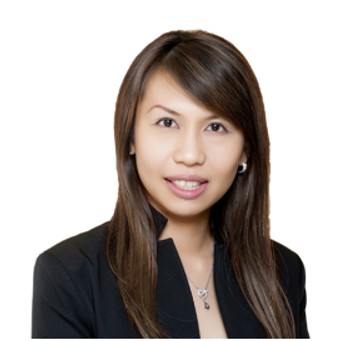
We carry this report of comments made at the recent AIWM (Singapore) conference in Singapore by president Jolene Tan.
Geopolitical uncertainties and rapid technological change are
putting a premium on expertise and reliability – qualities that
the
Association of Independent Wealth Managers (Singapore)
stresses are essential for sustainable growth.
External Asset Managers (EAMs) and other forms of independent,
non-bank players, which have grown in Singapore in recent
years, are held to the same standards of operation and
conduct as banks. However, as a sector as a whole, it is
relatively modest, Jolene Tan (main picture), AIWM (Singapore)
president, and managing partner, SingAlliance Pte Ltd, said in
the association’s recent conference held at Singapore
Management University. (See a
feature from last year about the EAM sector, examining
the angle of custodians.)
“As the macro environment becomes increasingly complex
– marked by shifting geopolitics, technological disruption
and evolving regulatory expectations – independent wealth
management firms are operating in a landscape that demands
greater clarity, conviction and collaboration,” Tan said in her
address.
“While Singapore’s independent wealth management sector remains
relatively small, firms are held to the same rigorous standards
as large financial institutions, even as they navigate similar
challenges – rising operating costs, talent retention
challenges and evolving client expectations – with leaner
teams and tighter resources,” Tan continued.
AIWM (Singapore) has more than 80 members. Exact numbers of
EAMs and other independent wealth players in total aren’t easy to
pin down. According to the Monetary
Authority of Singapore's 2024 Singapore Asset Management
Survey, the total industry’s AuM at the end of that year
reached S$7.07 ($5.47) trillion. The net number of licensed fund
management companies in Singapore rose from 1,250 as at December
2023 to 1,298 as at December 2024.
With tailwinds such as this, it is unsurprising that Tan and her
fellow members have been busy. In July 2025, AIWM (Singapore)
launched its AIWM Certification programme, designed to enhance
professional standards and the reputation of member firms; it
also expanded collaboration with industry groups and
institutions, such as the MAS Financial Hub and STEP Singapore,
to give just two examples.
Academic links
The very fact that Tan spoke at SMU for her April conference – attended by WealthBriefingAsia – highlighted another important area: close links with business schools and wider academia. (WBA interviewed SMU on its work here.)
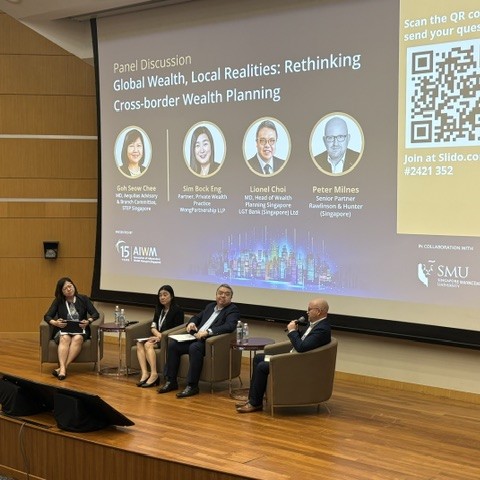
A panel discussion at the AIWM (Singapore) conference.
Collaboration
“Building on what we started together last year, it was especially meaningful for us to see this collaboration between AIWM and SMU continue and grow,” Tan said. “The energy, engagement, and quality of discussions this year really reflected what can be achieved, when the industry and academia come together with a shared purpose. I strongly believe that the development of our industry must go hand in hand with the cultivation of future talent and thought leadership, strengthening the bridge between theory and practice, and SMU’s collaboration plays a vital role in this.”
The “RIGHT” way
Tan said the association frames how the industry must operate by
the “RIGHT” approach, with “R” standing for “responsible
stewards”; “I” for “inquisitive”; “G” for “governance”; “H” for
“highly committed to grow”; and “T” for “team.”
As Tan has
explained to this news service before, the growth of Variable
Capital Company (VCC) structures, and Singapore’s rise as a major
family offices hub, are significant developments. As reported
only a
few days ago, MAS has announced the start of revised new
rules governing single-family offices (SFOs), taking effect from
15 June.
Among several topics discussed at the conference was
intergenerational wealth transfer and the related assumptions
that HNW families and their advisors might have. One discussion
point was how wealth holders preferred to “skip a generation” and
transfer some – not all – wealth straight away not to the
generation immediately below, but to grandchildren. This is
because many “NextGens” are in fact already settled in careers
and businesses.